Beta
This website is in development — content and design are still changing
Publication
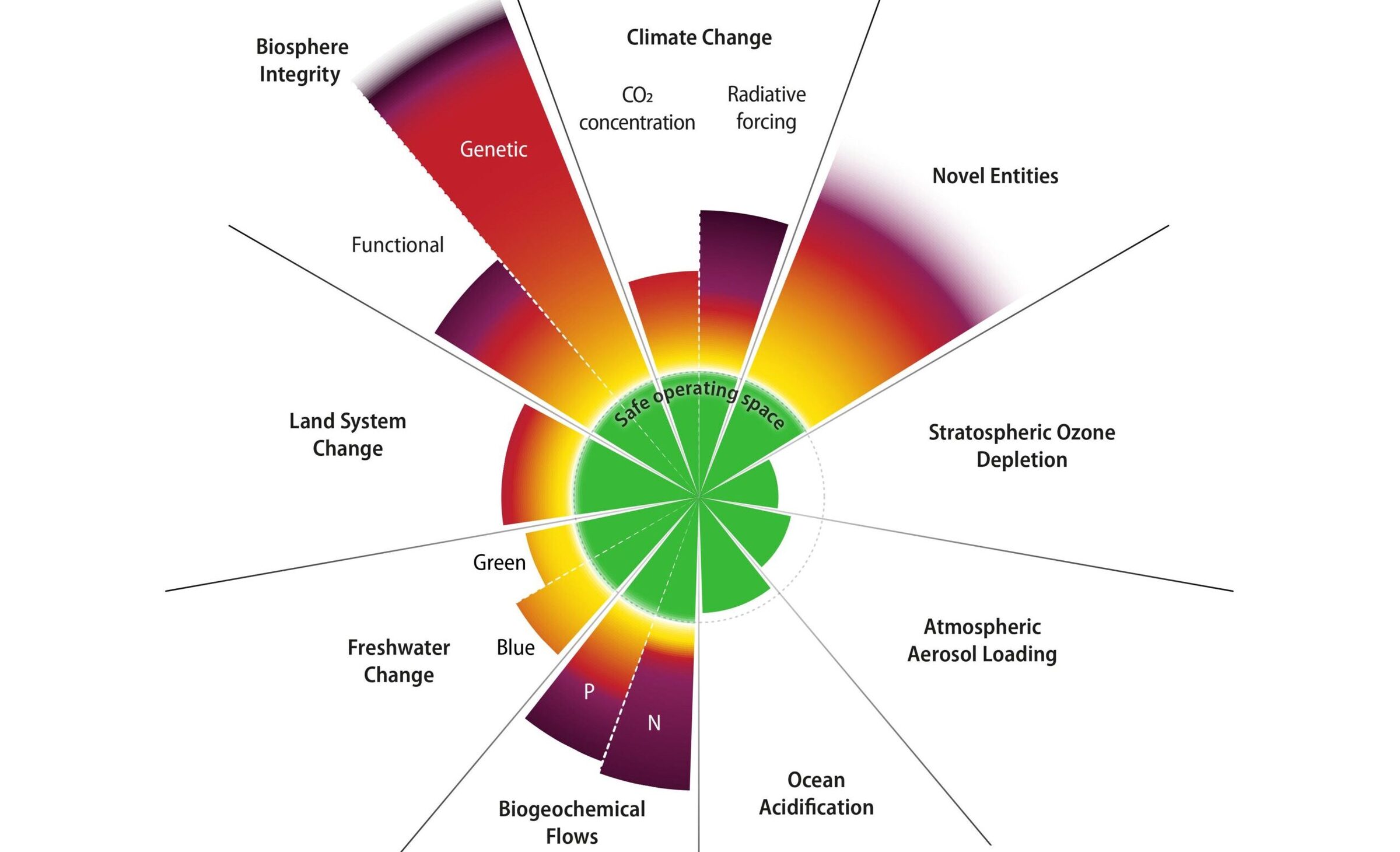
Earth beyond six of nine planetary boundaries
For the first time, an international team of scientists is able to provide a detailed outline of planetary resilience by mapping out all nine boundary processes that define a safe operating space for humanity. From global warming to the biosphere and deforestation, from pollutants & plastic to nitrogen cycles and
For the first time, an international team of scientists is able to provide a detailed outline of planetary resilience by mapping out all nine boundary processes that define a safe operating space for humanity. From global warming to the biosphere and deforestation, from pollutants & plastic to nitrogen cycles and freshwater: Six of nine planetary boundaries are being transgressed, while pressure in all those boundary processes is increasing, cutting-edge research published in the journal Science Advances shows.
The novel entities boundary has been quantified, and the assessment shows that it is transgressed. It includes the accumulation of all novel chemical compounds created by humans, such as micro-plastics, pesticides and nuclear waste. Also, in a first, there is now scientific evidence to quantify the boundary of atmospheric aerosol loading – this boundary is not transgressed yet, even though regional transgressions do occur, e.g., in South Asia. The freshwater boundary now addresses both green water (held in soil and plants in farms, forests etc.) and blue water (rivers, lakes etc) – both boundaries are transgressed. As another first, a control variable for the biosphere integrity was introduced – revealing evidence for another crossed boundary which in fact has been crossed since the late 19th century, when global agriculture and forestry saw major expansions. Planetary resilience goes well beyond climate change, the researchers underline.
The transition to a low-carbon economy is expected to increase material requirements, as low-carbon technologies (LCTs) typically require more materials than fossil fuel-based energy systems. Here, we extend the MEDEAS-Spain Integrated Assessment Model (IAM) to improve the representation of material requirements, stocks, and flows. Key novelties are: (i) the use
This study uses advanced machine learning algorithms to analyze the indicators influencing national climate ambition in 2030 emissions targets and net-zero pledges. By focusing on technical and social feasibility, and political credibility, we assess climate ambition of countries through cumulative per capita emissions from 2021 to the net-zero target year.
Foundation models for Earth systems have so far been trained primarily on physical climate and weather data, with limited representation of the human systems that both drive and respond to environmental change. The lack of a unified global training resource that combines climate, land, ocean, cryosphere, infrastructure, hazards, and socioeconomic