Beta
This website is in development — content and design are still changing
Model
REMIND
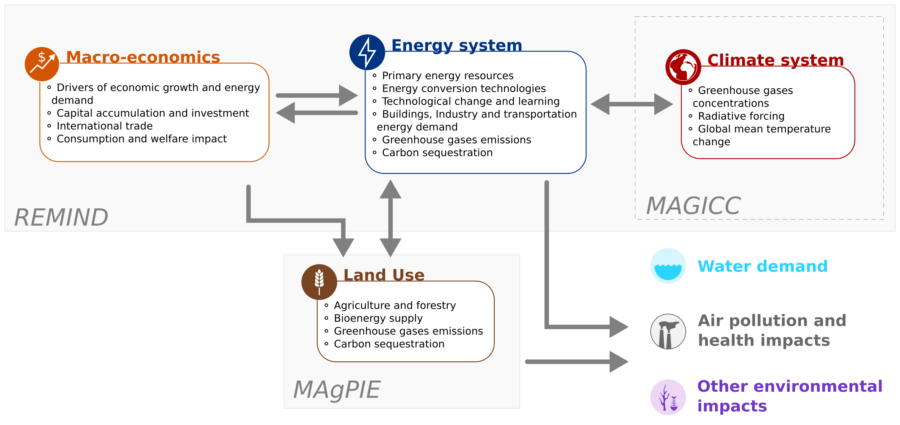
REMIND (REgional Model of Investment and Development) is a numerical model that represents the future evolution of the world economies with a special focus on the development of the energy sector and the implications for our world climate. The goal of REMIND is to find the optimal mix of investments
REMIND (REgional Model of Investment and Development) is a numerical model that represents the future evolution of the world economies with a special focus on the development of the energy sector and the implications for our world climate. The goal of REMIND is to find the optimal mix of investments in the economy and the energy sectors of each model region given a set of population, technology, policy and climate constraints. It also accounts for regional trade characteristics on goods, energy fuels, and emissions allowances. All greenhouse gas emissions due to human activities are represented in the model.
REMIND aims to help policy and other decision makers to plan ahead by understanding the roles, synergies and trade-offs between various factors, including population, resources, technologies, policies and the environment. Using REMIND, research and policy-relevant questions related to sustainability can be explored: Which technologies should we use in the future? What is the impact of policy proposals that are meant to prevent (mitigate) climate change? What are the consequences on economic development, air pollution, and land use? For some questions, REMIND is used in connection with other models to provide a detailed answer. One such model is MAgPIE (Model of Agricultural Production and its Impacts on the Environment).
On April 12, 2026, the Center for Global Sustainability at the University of Maryland, Peking University and Tsinghua University celebrated the release of GCAM-China-v8. This update introduces a series of new features, including harmonization with the latest global GCAM v8.2 framework, updating the base year to 2021, introducing a provincial-level
We are pleased to share several recent developments and resources that may be of interest to the community: Preprint on New SSP OperationalizationA preprint article has been released introducing a new operationalization of the Shared Socioeconomic Pathways (SSPs) for 188 countries through 2150. This work covers a wide range of
Bc3 is pleased to announce the release of the first version of GCAM-Europe, an expansion of the well-established GCAM model. The model is fully accessible via our GitHub repository: https://github.com/bc3LC-GCAMEurope