Beta
This website is in development — content and design are still changing
Model
IPAC
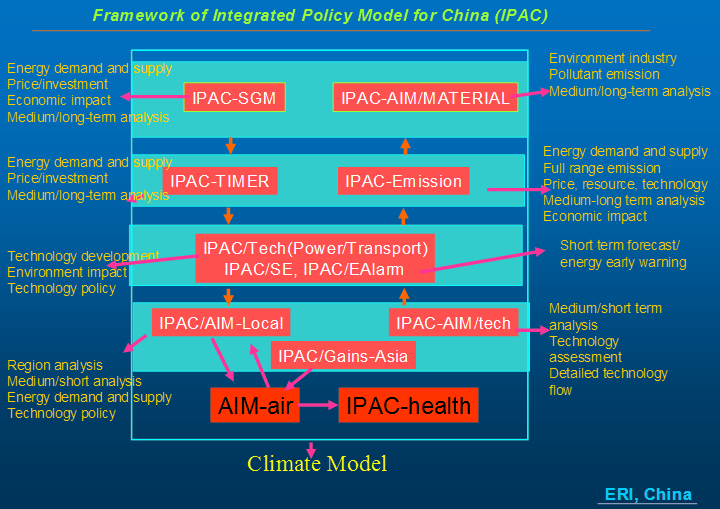
In order to quantify GHG emissions from various sources, a modeling framework was developed to analyze possible pathways of energy activities and GHG emissions for the world and China. Structure of IPAC is displayed in Figure 1. IPAC is a multi-model framework, which cover different modeling methodologies by focusing on
In order to quantify GHG emissions from various sources, a modeling framework was developed to analyze possible pathways of energy activities and GHG emissions for the world and China. Structure of IPAC is displayed in Figure 1. IPAC is a multi-model framework, which cover different modeling methodologies by focusing on various policy questions(see figure 2). These modules in IPAC are currently soft-linked, which means the output of one module is used as the input of another module. In IPAC-Global model, the modules have realized the hard link.
Now IPAC including global model, national model and regional models. There are two global models in IPAC, one is IPAC-TIMER model which originally come from IMAGE model, and the other one is IPAC-Global model, which was developed in the IPCC SRES scenario development process, and it will be used in this RoSE study. National models covers CGE model, technology simulation model. The provincial model, or regional model is using same model with national one of technology simulation, which cover all provinces in China. And recently, in order to support low carbon development in cities, city level technology models were developed.
IPAC-Global model is an extended version of the AIM-Linkage model used in IPCC Special Report on Emission Scenarios (SRES). This model links the social and economy development, energy activities and land use activities, and forms a full range of emission analysis. IPAC includes mainly four parts: (1) society, economy and energy activities module, which mainly analyzes the demand and supply in the condition of social and economic development, and determines the energy prices; (2) energy technology module, which analyzes the short and mid-term energy utilization technologies under different conditions, and determines the energy demand under different technology compositions. The energy demand in energy technology module will modify the short and mid-term energy demand in society, economy and energy activities module, which makes the energy analysis in macro-economic model better reflect the short and mid-term energy activities; (3) land use module, which analyzes the emissions from land use process. This mainly includes emissions from agricultural food supplies, stock raising, forest management and biomass energy production; (4) industrial process emission module, which mainly analyzes the emissions from all kinds of industrial productions. The society, economy and energy activities module is built based on ERB model developed by Pacific Northwest National Laboratory (PNNL) in US. Energy technology module is the IPAC-AIM/technology module developed collaboratively by Climate Change Strategies Assessment Research Team in ERI and National Institute of Environmental Studies in Japan. Land use module is modified and extended based on the AGLU model developed by PNNL.
On April 12, 2026, the Center for Global Sustainability at the University of Maryland, Peking University and Tsinghua University celebrated the release of GCAM-China-v8. This update introduces a series of new features, including harmonization with the latest global GCAM v8.2 framework, updating the base year to 2021, introducing a provincial-level
We are pleased to share several recent developments and resources that may be of interest to the community: Preprint on New SSP OperationalizationA preprint article has been released introducing a new operationalization of the Shared Socioeconomic Pathways (SSPs) for 188 countries through 2150. This work covers a wide range of
Bc3 is pleased to announce the release of the first version of GCAM-Europe, an expansion of the well-established GCAM model. The model is fully accessible via our GitHub repository: https://github.com/bc3LC-GCAMEurope