GLOBIO – Global Biodiversity Model for Policy Support MSA
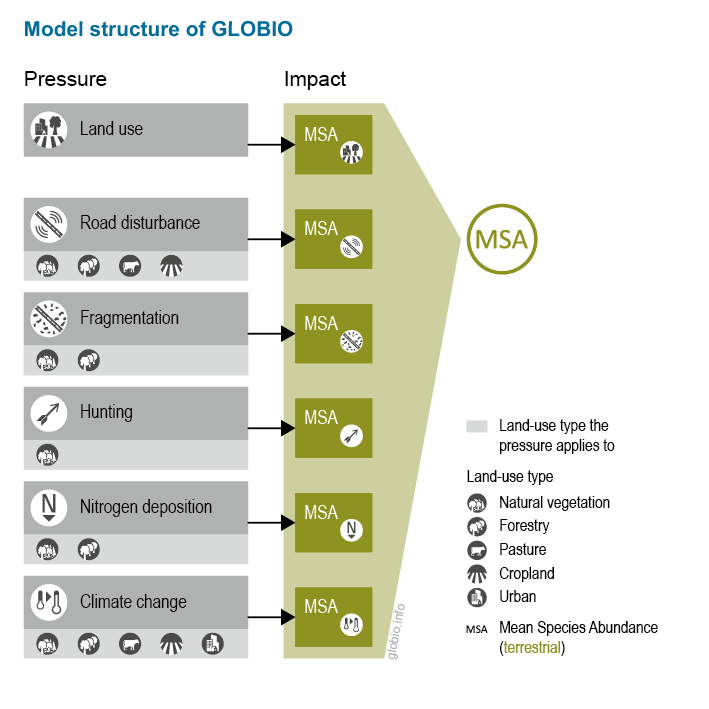
GLOBIO calculates local terrestrial biodiversity intactness, expressed by the mean species abundance (MSA) indicator, as a function of six human pressures: land use, road disturbance, fragmentation, hunting, atmospheric nitrogen deposition and climate change. The core of the model consists of quantitative pressure-impact relationships that have been established based on extensive
GLOBIO calculates local terrestrial biodiversity intactness, expressed by the mean species abundance (MSA) indicator, as a function of six human pressures: land use, road disturbance, fragmentation, hunting, atmospheric nitrogen deposition and climate change. The core of the model consists of quantitative pressure-impact relationships that have been established based on extensive terrestrial biodiversity databases.
GLOBIO combines the pressure–impact relationships with data on past, present or future pressure levels, typically retrieved from the IMAGE model. This results in maps with MSA values corresponding with each pressure. These maps are then combined to obtain overall MSA values, as illustrated in the figure. Next, MSA values are aggregated to larger (user-defined) regions. In addition, the contributions of the different pressures to the losses in MSA are quantified for each region.
GLOBIO also includes a routine to downscale coarse-grained land-use data to more fine-grained maps (currently with a resolution of 10 arc-seconds; ~300 m at the equator). This routine was developed because current global land‐use models have a relatively low spatial resolution hence tend to underestimate the spatial heterogeneity of land-use patterns. The downscaling routine requires regional totals or demands (‘claims’) of each land-use type and allocates these to the grid cells within the region in order of decreasing suitability for that land-use type.
On April 12, 2026, the Center for Global Sustainability at the University of Maryland, Peking University and Tsinghua University celebrated the release of GCAM-China-v8. This update introduces a series of new features, including harmonization with the latest global GCAM v8.2 framework, updating the base year to 2021, introducing a provincial-level
We are pleased to share several recent developments and resources that may be of interest to the community: Preprint on New SSP OperationalizationA preprint article has been released introducing a new operationalization of the Shared Socioeconomic Pathways (SSPs) for 188 countries through 2150. This work covers a wide range of
Bc3 is pleased to announce the release of the first version of GCAM-Europe, an expansion of the well-established GCAM model. The model is fully accessible via our GitHub repository: https://github.com/bc3LC-GCAMEurope