Beta
This website is in development — content and design are still changing
Model
EPPA – Emissions Prediction & Policy Analysis GHG
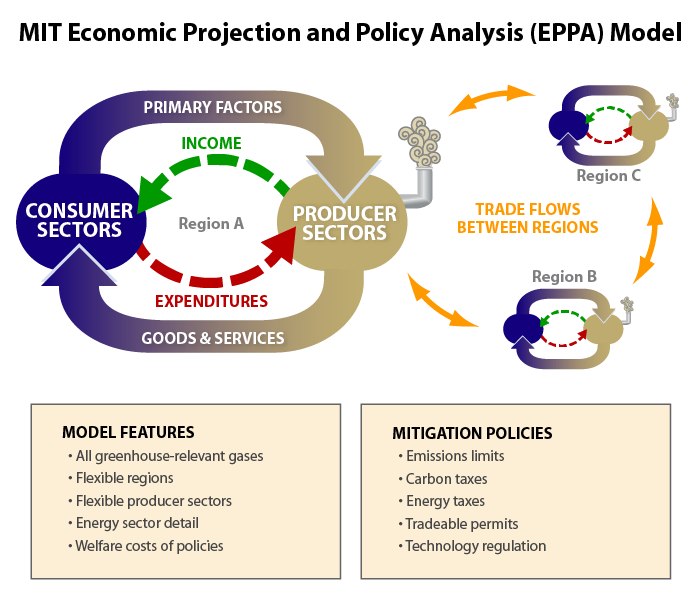
The EPPA model provides projections of world economic development at a regional and sectoral level, including the economic implications of greenhouse gas (GHG) emissions, conventional air pollution, land-use change, food demand, and natural resource use. EPPA simulates the evolution of economic, demographic, trade and technological processes involved in activities that
The EPPA model provides projections of world economic development at a regional and sectoral level, including the economic implications of greenhouse gas (GHG) emissions, conventional air pollution, land-use change, food demand, and natural resource use.
EPPA simulates the evolution of economic, demographic, trade and technological processes involved in activities that affect the environment. We use it to investigate the economic implications of a wide range of phenomena, including:
Climate and environmental impacts (e.g. changes in crop yields and human health)
Resource depletion and new technologies
Policies aimed at reducing emissions of GHGs and other pollutants
Policies aimed at limiting trade or land-use change
Deployment of specific technologies (e.g. wind power, solar power, carbon capture and storage, crop yield-enhancing technology)
Simulations of future emissions of GHGs and other pollutants as input for the MIT Earth System Model (MESM).
Land-use change and cover as input for the MIT Earth System Model (MESM).
The core model includes 18 global regions, but its framework has been applied with greater spatial, economic sector and household resolution for detailed studies.
The general framework is a multi-sector, multi-region, computable general equilibrium (CGE) model of the world economy. It utilizes the GTAP dataset (maintained at Purdue University) that includes input-output relationships among sectors within a broader social accounting matrix that includes exports, imports, government, investment and household demand for final goods, and the ownership and supply to each sector of labor, capital and natural resources.
On April 12, 2026, the Center for Global Sustainability at the University of Maryland, Peking University and Tsinghua University celebrated the release of GCAM-China-v8. This update introduces a series of new features, including harmonization with the latest global GCAM v8.2 framework, updating the base year to 2021, introducing a provincial-level
We are pleased to share several recent developments and resources that may be of interest to the community: Preprint on New SSP OperationalizationA preprint article has been released introducing a new operationalization of the Shared Socioeconomic Pathways (SSPs) for 188 countries through 2150. This work covers a wide range of
Bc3 is pleased to announce the release of the first version of GCAM-Europe, an expansion of the well-established GCAM model. The model is fully accessible via our GitHub repository: https://github.com/bc3LC-GCAMEurope