Beta
This website is in development — content and design are still changing
Model
DSK – Dystopian Schumpeter Meeting Keynes climate-economy agent-based model DSK
The Dystopian Schumpeter Meeting Keynes climate-economy agent-based model (DSK) is an agent based integrated assessment model for climate impacts and the study of climate fiscal and monetary policies. The DSK model is an agent-based simulation laboratory representing a global economy and its relationship with changes in climatic conditions. In particular, it
The Dystopian Schumpeter Meeting Keynes climate-economy agent-based model (DSK) is an agent based integrated assessment model for climate impacts and the study of climate fiscal and monetary policies.
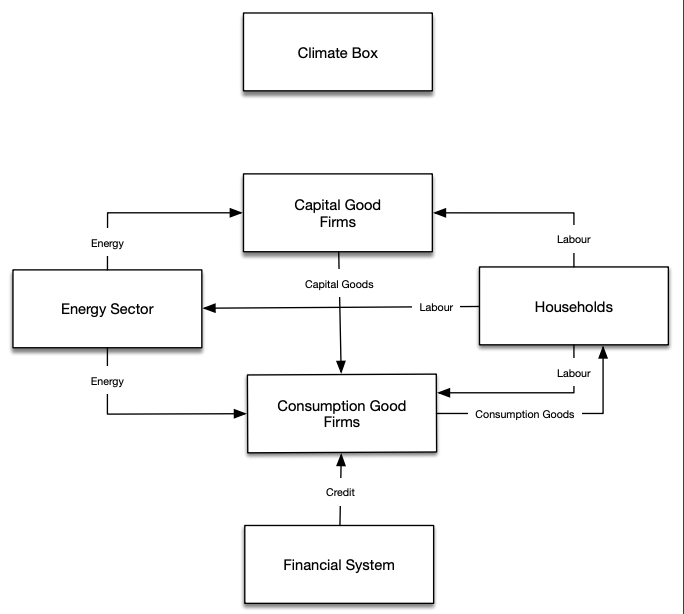
The DSK model is an agent-based simulation laboratory representing a global economy and its relationship with changes in climatic conditions. In particular, it features heterogeneous and interacting firms, devoted to the production of either capital or consumption goods and receiving inputs from an energy sector, a financial system and a variety of households (see Figure below). Firms’ production and investments can be financed externally through a financial system with multiple banks. Cumulative emission are linked to temperature variations through a climate module accounting for feedback loops. As a key innovative feature climate damages are modelled at the individual level and macro-level outcomes emerges from the agent’s interactions.
Indeed, the modelling philosophy merges a complex system approach, bounded rationality in economic decisions and evolutionary mechanisms of learning and innovation. These elements allow studying robust emergent properties from disaggregated interactions of ecologies of agents across different markets in general disequilibrium.
The model allows studying the intricate relationship between climate physical and transition risks as well as their macroeconomic effects. Further, it envisages a government and a central that run fiscal and monetary/macro-prudential policy, respectively.
On April 12, 2026, the Center for Global Sustainability at the University of Maryland, Peking University and Tsinghua University celebrated the release of GCAM-China-v8. This update introduces a series of new features, including harmonization with the latest global GCAM v8.2 framework, updating the base year to 2021, introducing a provincial-level
We are pleased to share several recent developments and resources that may be of interest to the community: Preprint on New SSP OperationalizationA preprint article has been released introducing a new operationalization of the Shared Socioeconomic Pathways (SSPs) for 188 countries through 2150. This work covers a wide range of
Bc3 is pleased to announce the release of the first version of GCAM-Europe, an expansion of the well-established GCAM model. The model is fully accessible via our GitHub repository: https://github.com/bc3LC-GCAMEurope