Beta
This website is in development — content and design are still changing
Model
BLUES – Brazilian Land Use and Energy System BLUES
The Brazilian Land Use and Energy System (BLUES) model is a perfect-foresight, least-cost optimization model for Brazil. It chooses the energy system configuration with the least total system cost over the entire time horizon of the study, in this case 2010 to 2050. The model minimizes costs of the entire
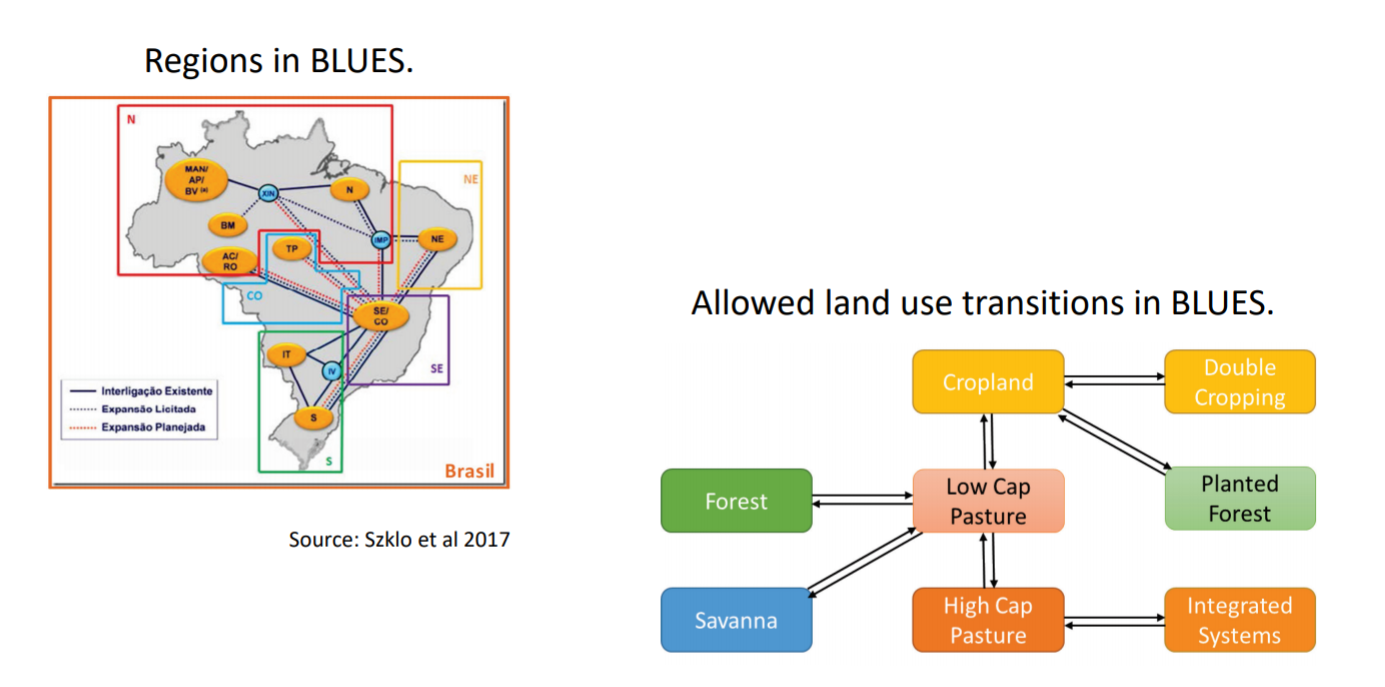
The Brazilian Land Use and Energy System (BLUES) model is a perfect-foresight, least-cost optimization model for Brazil. It chooses the energy system configuration with the least total system cost over the entire time horizon of the study, in this case 2010 to 2050. The model minimizes costs of the entire energy system, including electricity generation, agriculture, industry, transport and the buildings sectors. BLUES finds optimized mixes for the energy system as a whole, rather than evaluating sectorial optimal solutions. It includes CO2, CH4 and N2O emissions associated with land use, agriculture and livestock, fugitive emissions, fuel combustion, industrial processes and waste treatment.
BLUES has six native regions. One main overarching region into which five sub-regions are nested following the geopolitical division of the country. The energy system is represented in detail across sectors, with over 1500 technologies available in and customized for each of its six native regions. The representation of the land-use system includes forests, savannas, low- and high-capacity pastures, integrated systems, cropland, double cropping, planted forests, and protected areas. Cropland is made up of Land useis also regionalized and customized for each subregion, with yields and costs varying from region to region. Demand is exogenous but endogenous energy efficiency measures permit demand responses through technological options.
On April 12, 2026, the Center for Global Sustainability at the University of Maryland, Peking University and Tsinghua University celebrated the release of GCAM-China-v8. This update introduces a series of new features, including harmonization with the latest global GCAM v8.2 framework, updating the base year to 2021, introducing a provincial-level
We are pleased to share several recent developments and resources that may be of interest to the community: Preprint on New SSP OperationalizationA preprint article has been released introducing a new operationalization of the Shared Socioeconomic Pathways (SSPs) for 188 countries through 2150. This work covers a wide range of
Bc3 is pleased to announce the release of the first version of GCAM-Europe, an expansion of the well-established GCAM model. The model is fully accessible via our GitHub repository: https://github.com/bc3LC-GCAMEurope